Understanding the Scoville Scale: From Mild to Extreme Heat
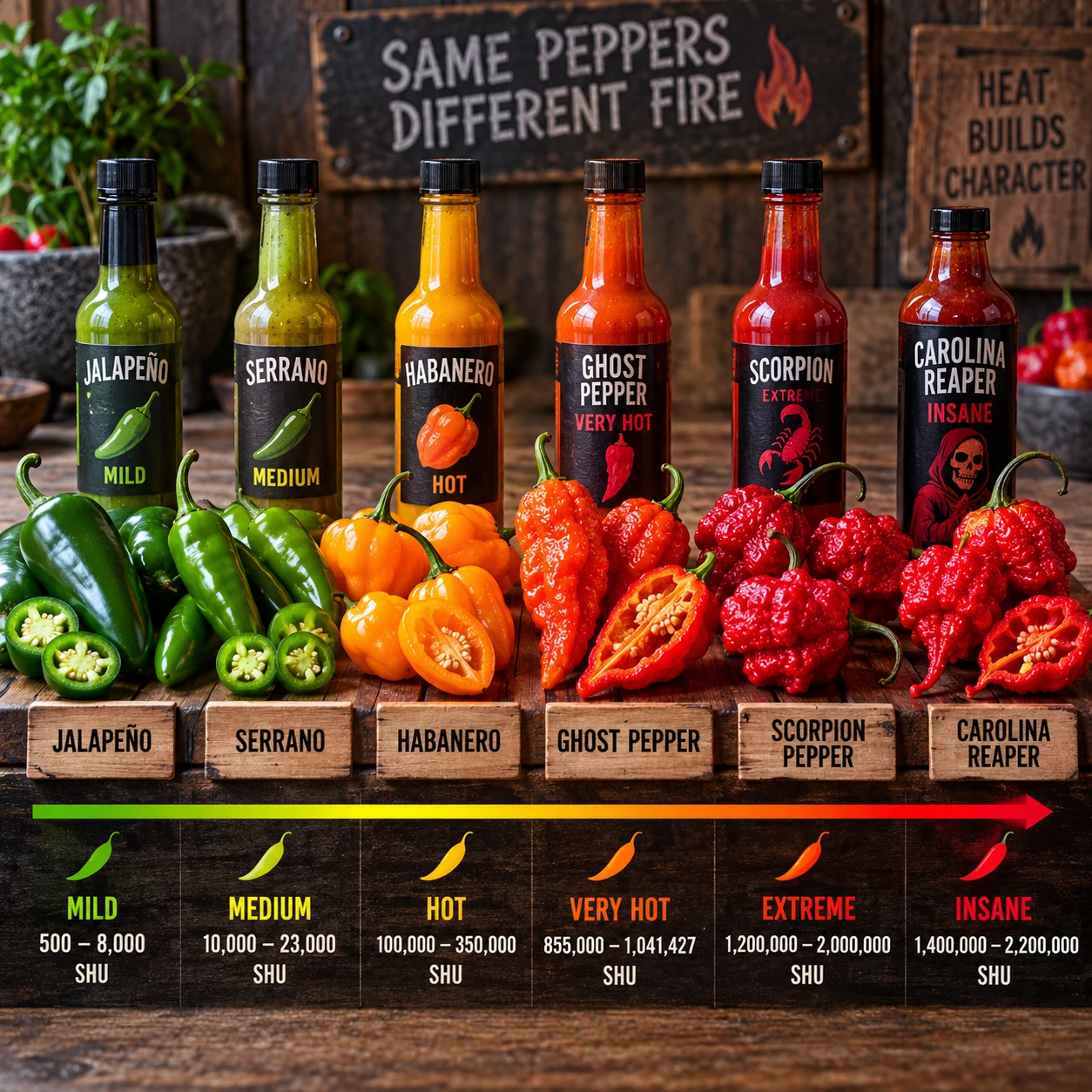
The Scoville scale gives chili pepper heat a number, making it easier to compare a gentle jalapeño with a searing ghost pepper. Those numbers are useful guides, but they do not tell the whole story: the heat in a finished hot sauce and the way it feels to you can both differ from a pepper’s rating.
What Is the Scoville Scale?
The Scoville scale is a way to express the heat of chili peppers and other products containing capsaicin. Its units, called Scoville Heat Units (SHU), indicate how much capsaicin is present, with higher numbers generally meaning greater potential heat.
Capsaicin is the compound responsible for the burning sensation associated with hot peppers. It activates heat-sensing receptors in the mouth, so the sensation is real, even though capsaicin does not physically raise the temperature of your food.
For a simple reference point, a bell pepper has no measurable capsaicin heat and is rated at 0 SHU. A jalapeño is commonly listed in the low thousands of SHU, while some of the world’s hottest peppers can reach well over a million. These are broad ranges, not guarantees for every pepper.
Think of SHU as a comparison tool rather than a precise prediction of your experience. Pepper variety, growing conditions, and the amount you eat all matter. A sauce’s label may also use a heat scale or tasting description instead of an SHU number, which can be more useful for judging how it fits into a meal.
How Is Pepper Heat Measured?
Pepper heat was originally measured with a taste test; modern laboratories measure capsaicinoids directly and use the results to calculate SHU. The modern method is more objective, though a number still cannot capture every detail of perceived heat.
In 1912, pharmacist Wilbur Scoville developed the Scoville Organoleptic Test. A pepper extract was diluted with sweetened water until a panel of tasters could no longer detect heat. The dilution level became the pepper’s SHU rating. For example, a sample that required substantial dilution received a higher rating.
The original test relied on human tasters, so results could vary with individual sensitivity and the panel’s judgment. Today, laboratories commonly use high-performance liquid chromatography (HPLC) to measure capsaicinoids, including capsaicin. Those measurements can then be converted into Scoville Heat Units.
Even lab results should not be treated as perfectly exact scores for every pepper. A rating may represent a range or a tested sample, and growing conditions can affect heat within the same variety. The National Institute of Standards and Technology explains how measurement methods depend on defined procedures; in the same spirit, SHU comparisons are most useful when you understand what was tested and how.
A Guide to Heat Levels, From Mild to Extreme
Chili pepper heat ranges from zero SHU in sweet peppers to more than a million SHU in some superhot varieties. Familiar examples make those wide differences easier to picture, as long as you treat each rating as an approximate range.
- Sweet and mild: Bell peppers have no capsaicin heat. Poblano peppers are generally mild, though their heat can vary.
- Gentle to moderate: Jalapeños commonly fall around 2,500–8,000 SHU. They bring a noticeable but often manageable kick to salsa, nachos, and everyday sauces.
- Hot: Habaneros are often rated around 100,000–350,000 SHU. Their heat can build quickly, alongside a fruity flavor that works well in many sauces.
- Very hot: Ghost peppers, also called bhut jolokia, have been reported in ranges around 800,000–1,000,000 SHU, though actual samples vary.
- Extreme: The Carolina Reaper has recorded ratings above two million SHU in specific tests. That figure describes exceptional tested peppers, not every fruit from the variety.
The jump between a jalapeño and a habanero is substantial, but the numbers do not tell you how a pepper tastes. A pepper’s flavor, aroma, and lingering heat all contribute to the experience. Extreme heat can be interesting for people who enjoy it, but it is only one quality among many.
Why Hot Sauce Heat Can Differ From Pepper Ratings
A hot sauce’s heat depends on its full recipe and serving size, not just the SHU rating of one pepper in it. Ingredients, pepper concentration, processing, and dilution can all change how much capsaicin reaches your mouth.
A sauce made with habaneros may taste less intense than a spoonful of concentrated pepper mash if it also contains tomatoes, fruit, vinegar, water, or other ingredients that spread out the pepper. Conversely, a small amount of a concentrated sauce can deliver a strong hit. The pepper’s published rating is therefore not a guaranteed rating for the finished bottle.
Recipe choices affect more than concentration. A sauce’s acidity, sweetness, salt, texture, and flavor balance shape how its heat comes across. A sweet fruit sauce can make the first taste feel approachable, while the capsaicin may still build after a few bites. Another sauce may deliver an immediate, sharp burn.
When comparing hot sauces, look for more than the pepper named on the label. Check the serving suggestion, ingredient list, and the brand’s own heat description. If a producer provides an SHU figure, see whether it refers to the pepper, an ingredient, or the finished sauce before comparing it with another product.
Why Heat Feels Different to Everyone
Perceived heat varies because people differ in sensitivity and tolerance, and because the amount eaten and accompanying food change the experience. One person may find a sauce pleasantly warm while another experiences the same serving as intensely hot.
People who regularly eat chili peppers may become more accustomed to the sensation, but tolerance is not a reliable way to predict how someone else will react. Recent exposure, individual sensitivity, and the particular sauce can all influence the burn. Even for one person, a few extra drops can change a dish’s heat noticeably.
Food pairings matter, too. A sauce mixed into a full meal is distributed across more food than the same amount tasted on its own. Dairy products such as milk or yogurt contain proteins that can help remove capsaicin from the mouth; water tends to spread it around rather than dissolve it. Starchy foods may help by giving you something substantial to eat, though they do not neutralize capsaicin.
Keep serving size in mind when tasting a new bottle. Start with a small amount, wait for the heat to develop, then add more if you want it. That approach gives you a better read on the sauce than judging it from one oversized taste.
How to Choose the Right Hot Sauce Heat Level
Choose a hot sauce by matching its heat to your comfort level, the dish, and how much control you want at the table. Start mild if you are unsure, then increase the amount gradually; a sauce should add enjoyment as well as heat.
Use a simple three-part check
- Your baseline: If jalapeño salsa feels comfortable, begin with a sauce described as mild or medium. If you already enjoy habanero heat, you may be ready to explore hotter options.
- Your purpose: For a sauce you can pour generously over eggs or tacos, choose a level you can use by the teaspoon. A very hot sauce may work better as a few drops stirred into a larger dish.
- Your control: When serving a group, offer a milder sauce at the table and keep a hotter bottle on the side. Each person can adjust their own portion.
Read tasting notes as carefully as heat labels. A jalapeño-based sauce may offer grassy freshness, while a habanero sauce may bring fruitiness along with a stronger burn. If a product gives an SHU value, treat it as a guide, especially when you do not know whether the figure applies to the pepper or the finished sauce.
A useful rule is to add sauce in small increments, stir, and taste the whole dish before adding more. You can always build heat; removing it after a heavy pour is much harder. If a meal ends up too hot, serve it with more of the same food, rice, or a dairy-based accompaniment to make each bite less concentrated.
Scoville Scale FAQs
What does SHU stand for?
SHU stands for Scoville Heat Units. It is a measurement used to express the heat associated with capsaicin in chili peppers and related products.
Is the Scoville scale exact?
No. Modern laboratory testing is more objective than the original taste test, but ratings can vary by sample and method. Use SHU as a comparison guide, not a promise of exactly how hot a pepper or sauce will taste.
Can a hot sauce be hotter than the pepper it contains?
A sauce can feel hotter per serving than you expect from a pepper’s rating if it is highly concentrated or you use a larger amount. But the pepper’s SHU rating alone does not establish the finished sauce’s rating; that depends on the recipe and testing.
How can I handle a sauce that is too hot?
Stop adding the sauce and dilute the dish with more of its other ingredients. Milk, yogurt, or another dairy food may help ease the mouth burn. For the next serving, use a smaller amount and mix it evenly through the food.